
No products in the basket.
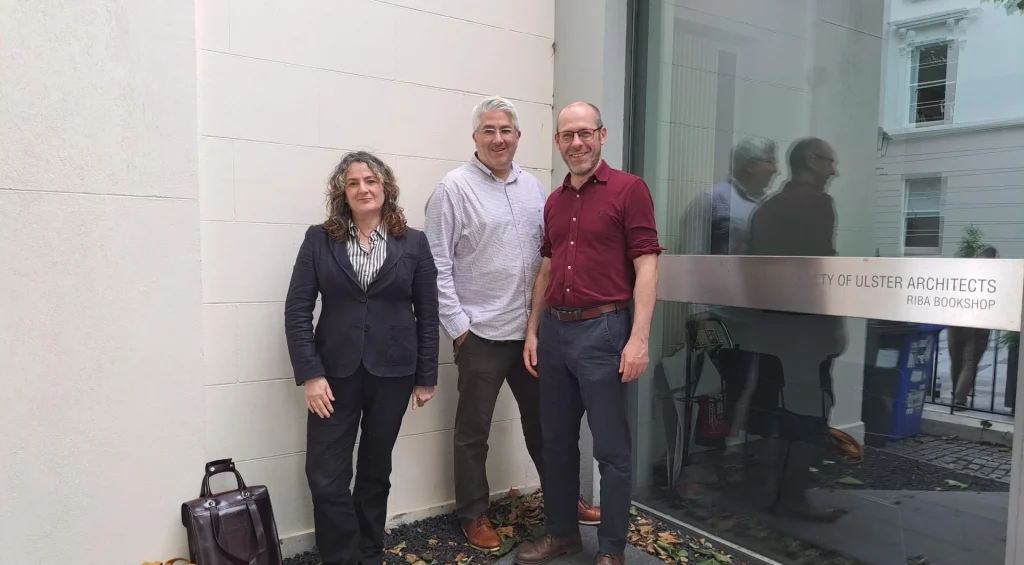
RSUA met today with Philip McClay, Director of Health Estates (HE) at the Department of Health (DoH), and Katherine Hanratty, Programme Director, to discuss how Health Estates engages with architects and to explore its future plans, following up on a discussion held in June 2025.
State of the Estate Report
HE referred attendees to the DoH’s State of the Estate Report 2024, which provides a snapshot of the condition of the health estate, performance data for approximately 1,500 buildings, and identifies risks and constraints affecting estate transformation to meet service needs.
Plans for 2026 and three-year budget
HE advised that both capital and revenue budgets remain severely constrained. However, several schemes are currently on site, including the New Children’s Hospital in Belfast, Lisnaskea Health and Care Centre and a midwifery-led unit at Antrim.
The scale of the estate continues to present significant challenges. Of the 2.3 million square metres of HE property, 5% is considered “grossly underused” (i.e. vacant) and 19% “underused” (i.e. could be used more effectively).
Backlog maintenance now stands at £1.6 billion. Given budget constraints, HE advised that there would be a greater focus on improving the performance of the existing estate.
Members were also advised that a listed buildings report is being developed by HE and will be circulated once completed.
Minor Works Consultancy Framework
A new Minor Works Consultancy Framework is under development. Originally expected in early 2026, it is now anticipated to launch later this year. The framework will cover projects of up to £5 million, an increase from the previous £1 million threshold, and will be divided into multiple lots across Northern Ireland.
It is proposed that consultant teams may be awarded a maximum of two lots, with the aim of distributing workload across a greater number of teams.
Pathway for architects to Health Estates work
HE indicated a desire to encourage new consultants, including architects, into healthcare work and is considering reducing the prerequisites related to previous experience on health projects.
HE agreed with RSUA’s suggestion to contact Damian McCarroll, Head of Construction Procurement at the Education Authority (EA), to understand how the EA procures through its own Minor Works Dynamic Shortlist.
Another RSUA suggestion taken forward was for HE to review a procurement mechanism used in the Republic of Ireland, under which contractors prepare a schedule of fees at the tender stage. They are then assessed on how they allocate resources within that schedule, helping clients judge the likelihood of delivery on time and within budget.
Design Competition 2026
HE reported that it is unlikely to run a design competition in collaboration with RSUA in 2026.
RSUA will remain in discussion with HE to explore future possibilities in this area.
Social Value criteria to support architecture placements
RSUA and HE agreed in principle that, depending on the nature of the brief, it would be reasonable to permit Part 1 and Part 2 architectural students to work on health projects as part of a wider team.
HE agreed to consider how its Social Value requirements could support this.
Whole-life carbon targets
HE reported that it is looking at embedding net zero requirements for embodied carbon into project briefs. The HE team is also represented on the NI Executive’s Public Buildings Working Group, which aims to ensure consistency on carbon requirements across government briefs.
HE is considering adopting the NHS net zero brief. It also noted that the Health and Social Care Trusts, along with the Northern Ireland Fire and Rescue Service, have already completed several projects across their existing estates with the aim of reducing carbon emissions.
AI update
HE reported that it is not yet using artificial intelligence (AI) in its procurement processes but is now using AI to transcribe and summarise internal meetings. HE stated that AI is a fast-moving area, and that it recognises that this technology will become more mainstream.
Separate appointments and project bank accounts
At the last meeting, RSUA suggested that HE consider separate appointments whereby the design team lead remains the single point of contact with the client but is not contractually responsible for the appointment or performance of other consultants.
To support this move, RSUA suggested the possible use of project bank accounts to allow payments to flow directly between the client and individual team members.
HE responded that separate appointments were unlikely, but there is potential for the Minor Works Consultancy Framework to be divided into two parts: a “Design Team”, procured and led by a Lead Consultant, and a “Contract Delivery Team”, procured and led by an NEC Project Manager. This Project Manager role could be fulfilled by professionals such as a quantity surveyor or NEC Supervisor, reflecting what was described by HE as a “halfway house” approach.
Health Estates’ queries
Under any other business, HE asked RSUA to provide feedback on the following topics, which will be addressed in due course:
Further engagement
If you have any questions or comments about this meeting, please contact Curtis Large, RSUA Policy and Public Affairs Officer, at curtis@rsua.org.uk
