
No products in the basket.
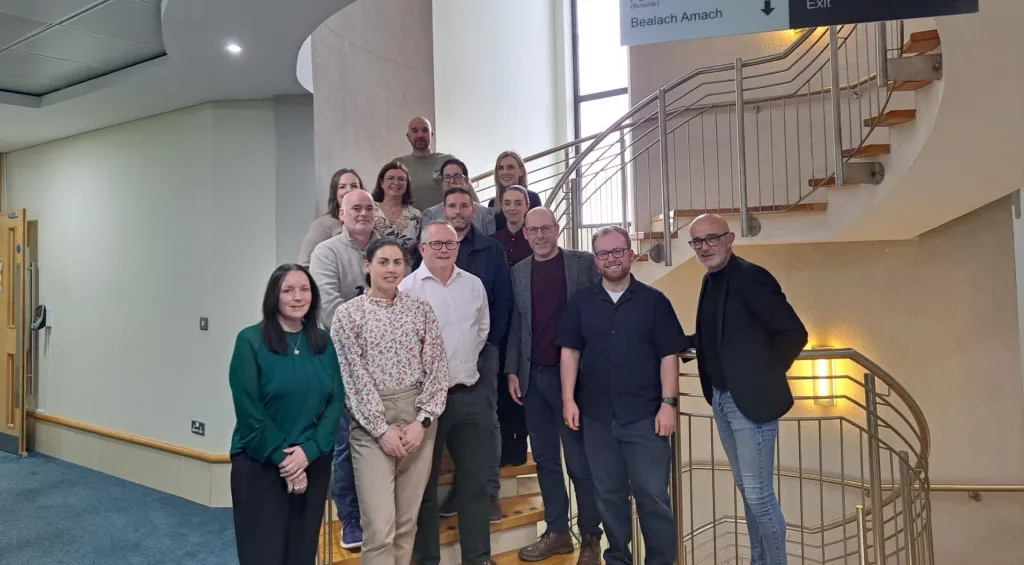
Mid Ulster District Council (MUDC) has updated RSUA on ongoing discussions with the Department for Infrastructure (DfI) concerning its Draft Plan Strategy.
DfI has requested a number of changes to the Strategy, with MUDC now preparing its response and a revised timetable for the Council’s Local Development Plan (LDP).
RSUA members received this update at a meeting today with Karen Doyle, Planning Service Lead for Local Planning, and Melvin Bowman, Planning Service Lead for Strategic Planning at the Council. Karen and Melvin were joined by Principal Planning Officers Grace Heron, Phelim Marrion, Roisin McAllister, Emma McCullagh and Colin McKeown.
RSUA was represented by Patrick Bradley, Edelle Henry, Aisling Irvine, Steven Kenning, Sara Love, Joseph Magill, Elaine McEldowney and Rachel Murphy.
Local Development Plan (LDP) progress
At our meeting last year, Mid Ulster District Council (MUDC) informed RSUA that negotiations were ongoing with the Department for Infrastructure (DfI) regarding concerns about the Council’s Draft Plan Strategy.
On 27 August 2026, DfI issued a request for MUDC to make 11 modifications to the Strategy. The Council informed RSUA that it would respond to the request as soon as possible and issue an updated LDP timetable accordingly.
RSUA also expressed a sense that the Draft Plan Strategy’s housing delivery ambitions were incompatible with existing wastewater capacity constraints. MUDC acknowledged the validity of this concern, particularly in relation to town centre development.
The Council noted that the drafting of the second-stage Local Policies Plan (LPP) would provide a later opportunity to review whether the proposed housing delivery plans are supported by the necessary infrastructure.
Planning Application Validation Checklist
On 6 August 2026, MUDC published its Planning Application Validation Checklist, which sets out the information, plans and supporting evidence that must be submitted with a planning application for it to be deemed “valid” and progress to processing.
The Council said the Checklist was designed to retain a degree of flexibility for applicants. It also confirmed that it would review the document’s effectiveness six months after publication and again after 12 months.
RSUA reported that it was seeing applications validated more quickly in the district.
Challenge of seasonal species surveys
Most planning authorities require applicants to submit both a Biodiversity Checklist and any ecological surveys identified by the Checklist before an application can be validated.
RSUA raised concerns that a shortage of ecologists, combined with delays in responses from the Northern Ireland Environment Agency (NIEA), means architects risk applications timing out. This is particularly problematic where species surveys can only be undertaken during specific seasonal windows.
MUDC agreed to review its approach, including if completion of a Biodiversity Checklist alone would suffice for validation.
Planning performance update
There has not been annual improvement in overall planning application processing times in MUDC, according to planning statistics issued by DfI.
On 31 March 2026, the Council had 424 planning applications that had been live for more than a year, 89% higher than the Northern Ireland average of 224. This represented a 20% increase in the Council’s legacy applications from the same date in 2025, when it had 352 such applications, 62% higher than the Northern Ireland average of 217.
The balance of applications in the district is heavily skewed towards local applications. Across 2025–26, the Council received nine major applications compared with 1,056 local applications.
The average processing time for locals was 22.4 weeks, 14% longer than the Northern Ireland average of 19.6 weeks. During 2024–25, the average processing time was 16.5 weeks, 13% faster than the Northern Ireland average of 19 weeks.
The Council highlighted the ongoing challenge posed by the high volume of planning applications being brought before Planning Committee. In response, the Planning Department has developed emerging proposals to increase the number of objections required for an application to be referred to the Committee.
RSUA welcomed this as a positive step and will consider writing to MUDC councillors to advocate for greater delegated authority for planning officials, whilst maintaining the ability for any application to be called in for Committee consideration.
NI Water connections for existing buildings
RSUA raised concerns that NI Water’s current policy presents a barrier to bringing vacant buildings back into use, as it requires developers to provide sufficient evidence of a like-for-like use within the previous five years in order to be reconnected to the public wastewater network.
We noted that there appears to be no legislative requirement for this approach and that, where NI Water recommends refusal on this basis, the ultimate decision rests with the Council.
MUDC agreed to keep RSUA informed of any developments in its approach to planning decisions involving existing buildings, particularly where it is seeking to address the constraints imposed by NI Water policy.
Further engagement
If you have any questions or comments about this meeting, or would like to join the RSUA Mid Ulster Local Group, please contact Curtis Large, RSUA Policy and Public Affairs Officer, at curtis@rsua.org.uk
