
No products in the basket.
In a departure from most planning authorities in Northern Ireland, Lisburn and Castlereagh City Council (LCCC) has confirmed that planning applications can be validated without seasonal species surveys being submitted at the outset.
A Biodiversity Checklist is still required, but applicants can proceed by confirming that an ecologist has been instructed and providing a timetable for the necessary surveys to be completed.
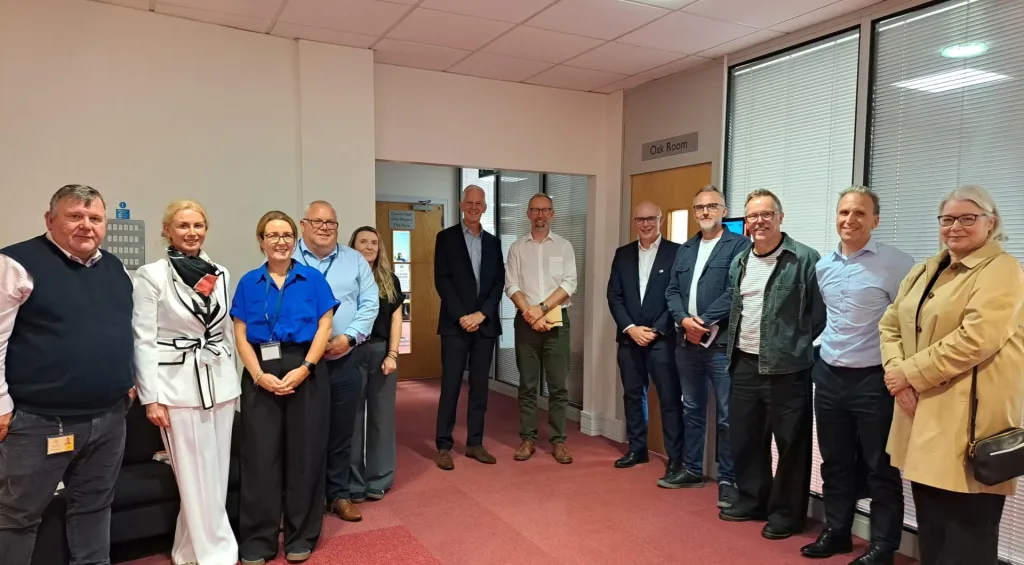
RSUA members heard the update at a meeting today with the Council’s Head of Planning Conor Hughes, alongside members of the senior team Laura McCausland, Peter McFadden, Gillian Milligan, Patrick Savage and Joanne Templeton.
RSUA was represented by Jonny Cassidy, Sarah Galway, James Keenan, Shane Loughran, Andrew McCready, Mark McCullough, Flora McGirr, John O’Connor and Roger Perrott.
Local Development Plan progress
Like all councils in Northern Ireland, LCCC is preparing a Local Development Plan (LDP), which will provide the primary basis for determining planning applications.
The LDP comprises two parts: the Plan Strategy, which sets out the strategic planning policy framework across a range of areas, including housing, employment and infrastructure; and the Local Policies Plan (LPP), which implements the Strategy through more detailed proposals, such as land-use zonings and settlement limits.
In September 2023, the Council adopted its Plan Strategy, which runs to 2032. When RSUA last met with LCCC in September 2025, the Council advised that it was aiming to have the LPP drafted by September 2026, after which public consultation and an independent examination would take place.
The Council advised in our meeting that a combination of internal and external pressures, including the implications of the Department for Infrastructure’s (DfI) Eastern Transport Plan (ETP) 2035, has prompted a review of its LDP timetable.
A delay of approximately nine months is now anticipated, with the LPP expected to be drafted by June 2027.
Planning Application Validation Checklist
LCCC’s Draft Planning Application Validation Checklist was subject to public consultation from December 2025 to February 2026.
This Checklist will be published and operational from 1 October 2026.
Challenge of seasonal species surveys
Most planning authorities require applicants to submit both a Biodiversity Checklist and any ecological surveys identified by the Checklist before an application can be validated.
RSUA raised concerns that a shortage of ecologists, combined with delays in responses from the Northern Ireland Environment Agency (NIEA), means architects risk applications timing out. This is particularly problematic where species surveys can only be undertaken during specific seasonal windows.
We highlighted that this creates significant cash-flow pressures for practices, risks seasonal bottlenecks in the planning system and may inadvertently encourage landowners to clear sites to avoid delays.
LCCC advised that it takes a more flexible approach. While a Biodiversity Checklist is required, an application can be validated where the applicant provides a statement confirming that an ecologist has been instructed and setting out a timescale for the required surveys.
In response to various suggestions for addressing the overall challenge, including the possibility of seasonal surveys being negatively conditioned, the Council advised that NIEA is developing new guidance intended to make it easier to validate applications in relation to bats.
LCCC said it will review the situation over the next six months, taking account of any further direction issued by NIEA.
Planning performance update
According to the latest planning statistics published by DfI covering the end of 2025, the Council had 250 planning applications that had been live for more than a year, 10% higher than the Northern Ireland average of 227.
This represented a 35% decrease in the Council’s legacy applications from the end of 2024, when it had 385 such applications, 75% higher than the Northern Ireland average of 220.
The profile of applications in the district is heavily skewed towards local applications. Across the first three quarters of 2025, the Council received seven major applications compared with 466 local applications.
The average processing time for local applications during this period was 32 weeks, 63% longer than the Northern Ireland average of 19.6 weeks. During the same period in 2024, the average processing time was 38 weeks, 99% longer than the Northern Ireland average of 19.1 weeks.
Wastewater capacity constraints
Wastewater infrastructure constraints continue to limit new development in parts of the Council area.
New Holland treatment works in Lisburn is under severe pressure, with capacity problems also affecting Huguenot Drive and catchments around Dundonald, Castlereagh and Glenavy.
Additional wastewater ultimately affects receiving waters such as Belfast Lough, which is protected under European environmental designations. This means Shared Environmental Services must consider the cumulative impact of development, making it increasingly difficult to rely on planning conditions where infrastructure is insufficient.
RSUA was advised at the meeting that around £55m of work is being applied to remediation in Lisburn city, while significant works are also under way in Carryduff, where NI Water is installing underground stormwater storage to increase capacity in the local network.
Further engagement
If you have any questions or comments about this meeting, or would like to join the RSUA Lisburn and Castlereagh Local Group, please contact Curtis Large, RSUA Policy and Public Affairs Officer, at curtis@rsua.org.uk
