
No products in the basket.
Armagh City, Banbridge and Craigavon (ABC) Borough Council has agreed a revised timetable for its Local Development Plan (LDP), with its Draft Plan Strategy expected to be published for public consultation in August.
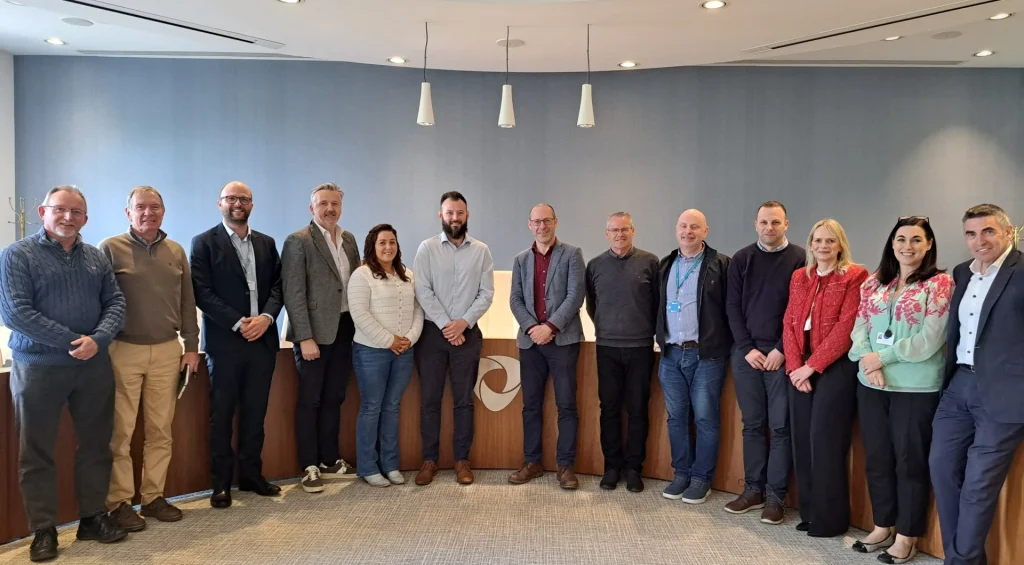
RSUA members heard the update at a meeting today with the Council’s Head of Planning, Robbie McNaugher, Principal Planning Officers Kyle Elder, Roisin Hamill and Helen Stoops, and Head of Building Control, Tom Lavery.
RSUA was represented by Bronagh Curry, William Dunne, Jimmy McAdam, David McMaster, Sam Nicholson, Jeffrey Sergeant and Colin Stewart.
Local Development Plan
Like all councils in Northern Ireland, ABC is preparing an LDP to provide the primary basis for determining local planning applications.
The LDP comprises two parts: the Plan Strategy, which sets out a strategic policy framework across a range of areas, including housing, employment and infrastructure; and the Local Policies Plan (LPP), which implements the Strategy through more detailed measures such as zoning and settlement limits.
RSUA advised that the Council should communicate in advance any changes between the draft and the published strategy, as planning applications will be prepared based on the draft and may be affected when the final version is adopted.
The Council agreed to consider this challenge.
Planning Application Validation Checklist
A source of frustration among RSUA members has been the difficulty of undertaking seasonal species surveys when seeking validation of a planning application.
Planning authorities are legally required to request that applicants provide both a Biodiversity Checklist and any associated surveys identified by that checklist at the outset of an application.
However, due to a shortage of ecologists and recent delays in responses from the Northern Ireland Environment Agency (NIEA), which approves the checklist, architects risk applications “timing out”, as seasonal species surveys can only be carried out during specific survey windows. This can create significant cash-flow issues for practices.
In response, the Council advised that its approach is to identify, at a single point in the process, whether early-stage surveys are required, after which the applicant can decide whether to proceed with an application.
RSUA agreed this was a sensible stopgap approach, further proposing that completion of the Biodiversity Checklist alone should be sufficient for an application to be deemed valid.
Planning performance update
The Department for Infrastructure (DfI) reported planning statistics for the Council in Q3 (October–December 2025) as follows:
These figures mean the Council in Q3 was outside the statutory target for majors (30 weeks) and locals (15 weeks).
Within the Planning Department, it was reported that staffing levels are beginning to stabilise, with planners being reallocated between teams in line with service priorities. The situation remains under review.
Planning Service Business Plan
ABC Council has published its Planning Department Draft Business Plan for April 2026 to March 2027, which provides information on the Department’s priorities and planned actions for the year ahead, together with the associated performance measures against which progress will be monitored.
The Business Plan sets out several enhancements to the planning service, including:
Additional items
Further engagement
If you have any questions or comments about this meeting, or would like to join the RSUA Armagh City, Banbridge and Craigavon Local Group, please contact Curtis Large, RSUA Policy and Public Affairs Officer, at curtis@rsua.org.uk
