
No products in the basket.
Derry City and Strabane District Council has published a Preferred Options Paper proposing changes to its Houses in Multiple Occupation (HMO) policy, with the aim of preventing high concentrations of HMOs in particular areas and supporting a more balanced mix of housing.
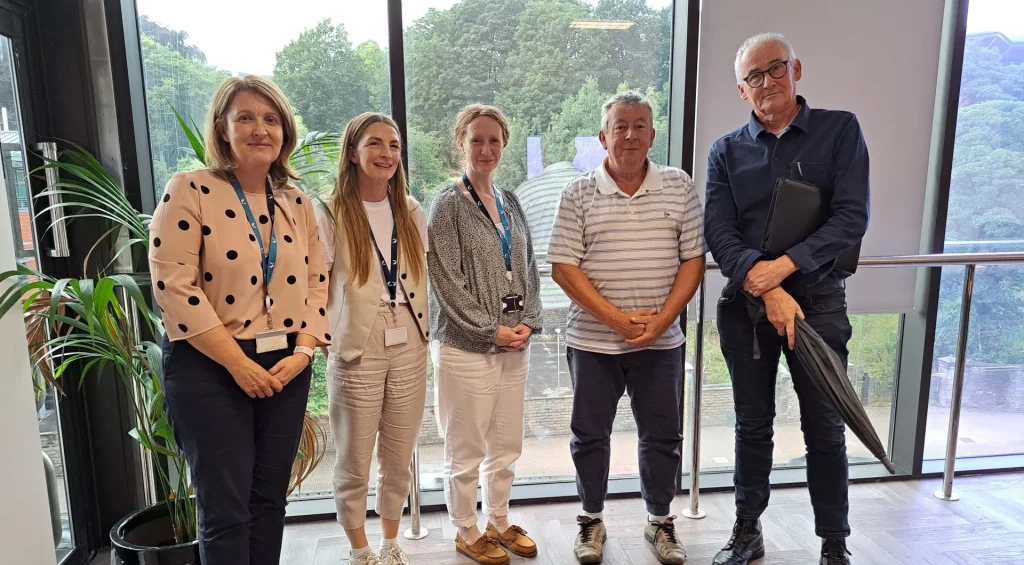
RSUA members heard the update at a meeting today with the Council’s Head of Planning Suzanne McCracken, alongside members of the senior team Rosemarie McMenamin, Ciaran Rodgers, Laura Coyle, Malachy McCarron and Rory Doherty.
RSUA was represented by Local Group Chair, Paul McGarvey, together with Simon Adeyinka, Eoighin Farren, Sarah Galway, David Graham, Brian McKevey, Brian Muldoon and Peter Tracey.
Local Development Plan progress
Like all councils in Northern Ireland, DCSDC is preparing a Local Development Plan (LDP), which will provide the primary basis for determining planning applications.
The LDP comprises two parts: the Plan Strategy, which sets out the strategic planning policy framework across a range of areas, including housing, employment and infrastructure; and the Local Policies Plan (LPP), which implements the Strategy through more detailed proposals, such as land-use zoning and settlement limits.
In July 2025, the Council adopted its Plan Strategy. Since then, it has been preparing Supplementary Planning Guidance (SPG) intended to support, clarify and illustrate the application of the adopted policies. Five of the planned 18 SPGs have now been finalised.
The Council has also recently published a Preferred Options Paper proposing revisions to its HMO policy, including reducing the interim cap on HMOs from 30% to 10%, introducing new anti-clustering measures and clarifying how HMO concentrations are assessed.
DCSDC’s overall LDP timetable was revised in July 2026, with the draft LPP now scheduled for publication for consultation by the end of 2028, followed by its adoption by 2029.
Challenge of seasonal species surveys
The Council’s Quality Submission Guide, which includes a Planning Application Validation Checklist, was subject to public consultation in November 2025. Following the consultation, the Guide became operational in June 2026.
Most planning authorities, including DCSDC, require applicants to submit both a Biodiversity Checklist and any ecological surveys identified by that checklist before an application can be validated.
RSUA said a shortage of ecologists and delays in responses from the Northern Ireland Environment Agency (NIEA), which reviews the Biodiversity Checklist, mean architects risk applications timing out, as many species surveys can only be undertaken during specific seasonal windows.
We warned that this creates significant cash-flow pressures for practices, risks seasonal bottlenecks in the planning system and may inadvertently encourage landowners to clear sites to avoid delays.
RSUA therefore recommended that a completed Biodiversity Checklist should be sufficient to validate an application initially, with any required seasonal surveys submitted later in the process.
The Council stated that it did not intend to change its approach at this time, maintaining that a Biodiversity Checklist alone would not provide sufficient information to validate an application upfront where ecological surveys were also required.
However, the Council said it would be keeping this matter under review and would update RSUA as necessary.
Planning performance update
According to the latest planning statistics published by the Department for Infrastructure (DfI), at the end of 2025, the Council had 281 planning applications that had been live for more than a year, 24% higher than the Northern Ireland average of 227.
This represented a 30% increase in the Council’s legacy applications from the end of 2024, when it had 216 such applications, 2% lower than the Northern Ireland average of 220. The Council advised the process of adoption of the LDP Plan Strategy in July 2025 had contributed to this increased figure.
The profile of applications in the district is heavily skewed towards local applications. Across the first three quarters of 2025, the Council received 15 major applications compared with 434 local applications.
The average processing time for local applications during this period was 24.4 weeks, 25% longer than the Northern Ireland average of 19.6 weeks. During the same period in 2024, the average processing time was 20.6 weeks, 8% longer than the Northern Ireland average of 19.1 weeks.
Shortly after RSUA last met with DCSDC in July 2025, the Council published its Annual Performance Report for 2024/25, setting out its performance against improvement objectives, statutory duties and corporate plan commitments.
The Report highlighted that the Council was not meeting the statutory processing targets for either major or local applications.
However, the Council has introduced additional measures, including the Quality Submissions Guide, which it expects will help to improve processing times across the district.
Protecting listed buildings
RSUA raised concerns about the wider implications of Planning Committees granting retrospective approval for previously unauthorised works to listed buildings. Decisions of this nature could create a precedent and send a message that it is preferable to undertake works first and seek consent afterwards, with the expectation that approval may subsequently be granted.
We stated our belief that applications of this nature should be subject to appropriate scrutiny and rigorous examination to safeguard Northern Ireland’s built heritage.
Future collaboration
RSUA informed the Council of our co-ordinated campaign to establish a City and Council Architect role in Northern Ireland to help place architecture back at the heart of local government thinking. We committed to sending the planners our position paper once finalised.
We drew the Council’s attention to the RSUA Design Quality Panel, which can support local authorities by providing an agile and cost-effective service that offers design expertise through design reviews for planning applications.
Further engagement
If you have any questions or comments about this meeting, or would like to join the RSUA Derry City and Strabane Local Group, please contact Curtis Large, RSUA Policy and Public Affairs Officer, at curtis@rsua.org.uk
