
No products in the basket.
This article is featured in Volume 34. Issue 6 of Perspective magazine, to purchase a copy click here.
The stone tower house in its various forms is a frequent occurrence in both Ireland and Scotland, usually a defensive residence, often surveilling a strategic topographical condition. Culmore Point is a lateral protrusion attached to the concave eastern flank of the majestic Inishowen peninsula, pinching the Foyle as it slips from river to lough, counterpointed to the north by Magilligan Point where lough meets sea between counties Derry and Donegal.
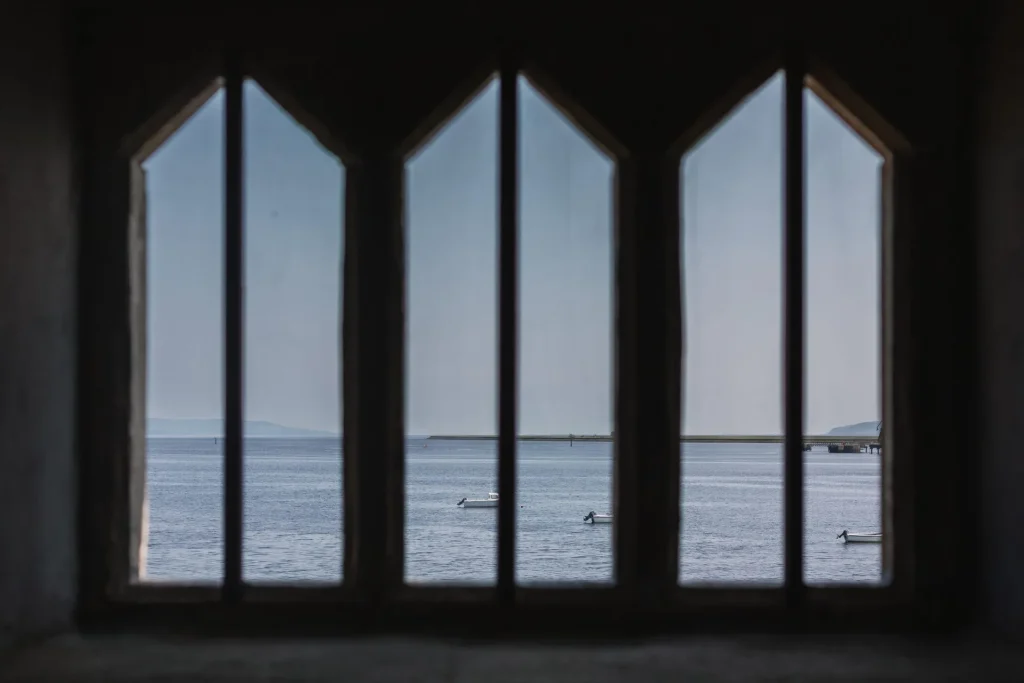
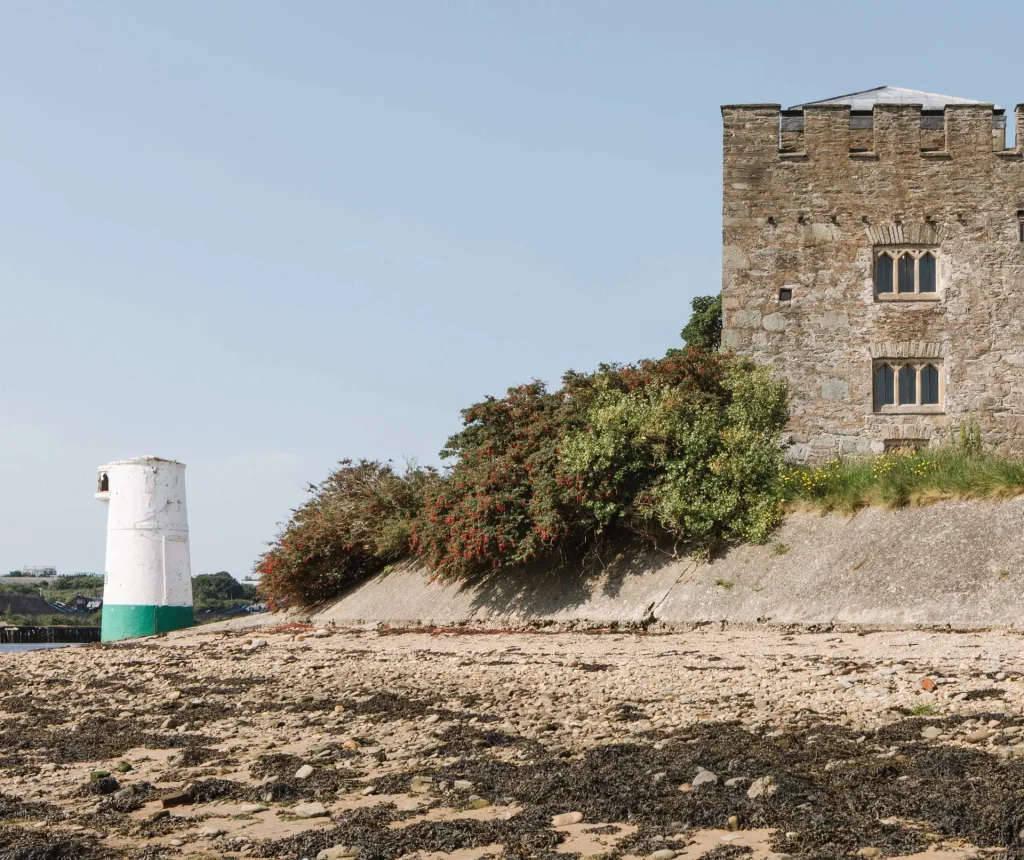
On the Point sits a fort that has witnessed events both momentous and quotidian: the blockade of Derry (1689) and the surrender of much of the U-boat fleet (1945) to name two of the more significant. It served as a ferryman’s house into the twentieth century – the ferry crossings timed to meet what was then the Londonderry and Coleraine Railway at Culmore Station, a mere 300 metres across the River Foyle.
The cultural importance of the site and this building is self-evident. That the building’s future is now secured (and at modest cost) is a testament to the strength of local community action and the intelligence of an enlightened owner. There are lessons here given how we seem to struggle with larger projects – struggle in terms of both delivery and value.


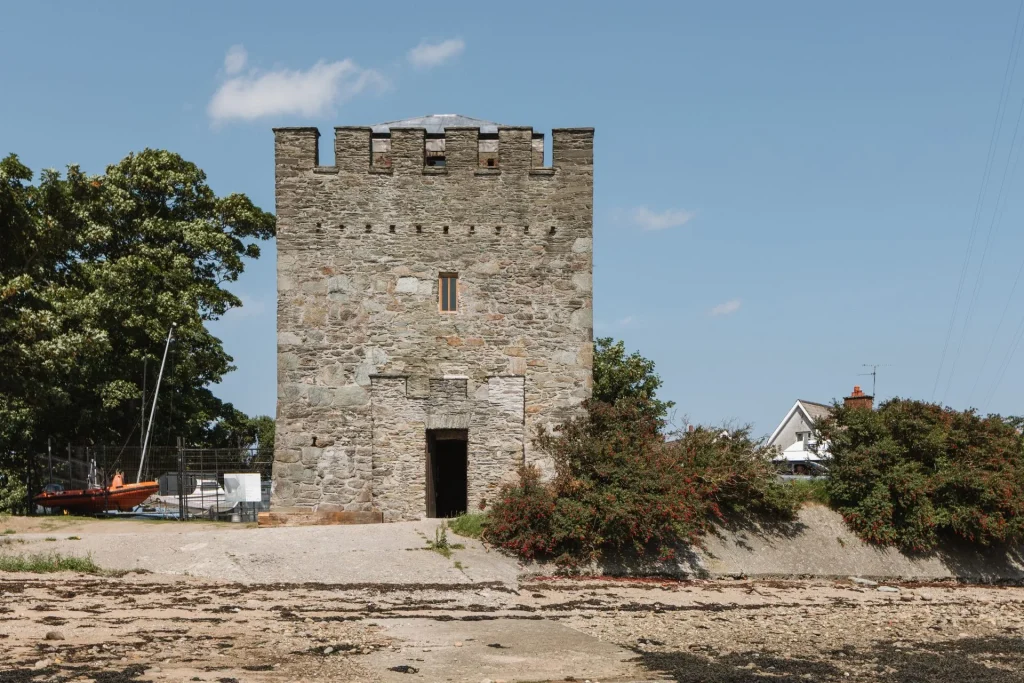
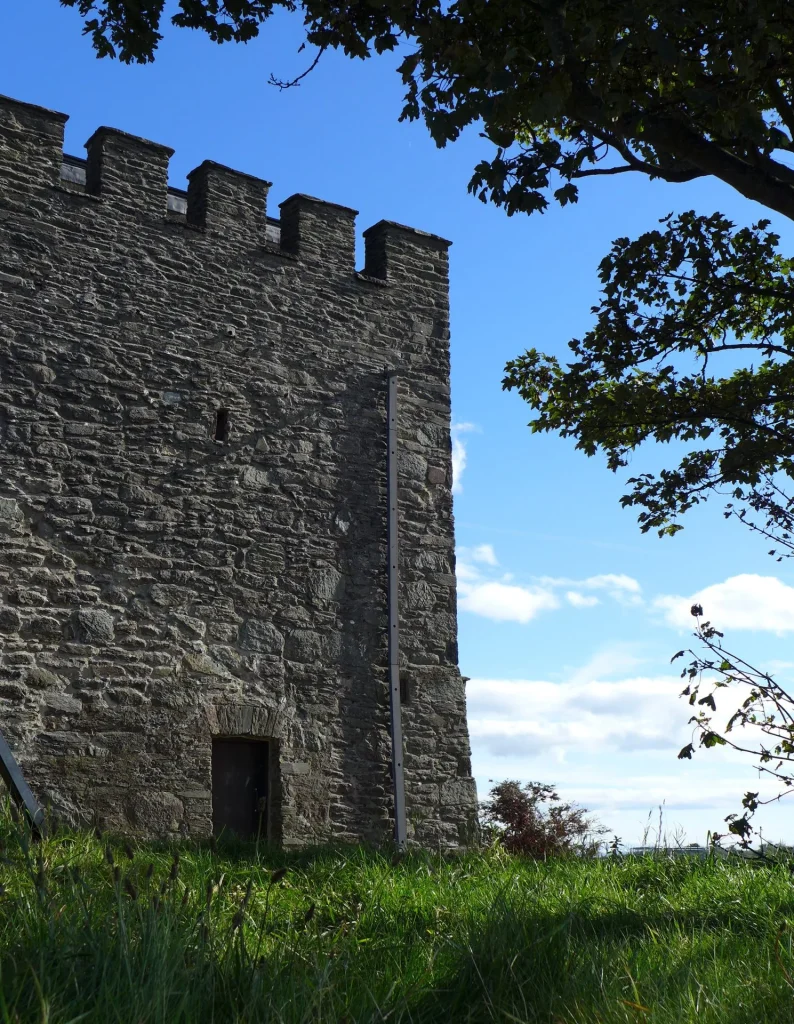
The formal and spatial character of the Fort is obvious; a solid stone heft anchored by gravity, its verticality minimising its footprint and its upright stance providing an existential register as it is perceived by us (generally) upright humans. The visual attributes are clear, a stone piece to be read in the round, a singular completeness. Typically such stone towers would have an enclosed bawn distinct from the tower and the available historical data indicates various attempts at enclosing battlements and earth works, all now disappeared. Here the 19th century brought various embellishments, aesthetic in nature – the exaggerated battlements, the attached porch.
This project involved the careful revelation of the tower, the consolidation of tones and finishes such that the singularity of the tower would read; the exterior has regained its quiet heft, a medley of mortars and limestones with sandstone window surrounds. Judicious attention to the stonework has revealed the various additions, coursings, imprints, infills, extensions, drips, removals – marks over time. Two steel rainwater hopper and downpipes are the now new additions – their quirkiness an appropriate foil. The new lead-clad roof is all but hidden by the unusually high battlement, its dark presence glimpsed through the parapet.


Within European culture we have two dominate conceptualisations of space, reflected in English words room and space. The former (room or raum in German) refers to the spatial condition made through removal, where extraction is the spatial generator, the metaphorical clearing in the forest. Space on the other hand has its root in the Latin spatium and extensio, and it implies a continuity between interior and exterior, field being its equivalent metaphor. Modernism favoured space rather than raum, with some exceptions (Adolf Loos for one), and this predisposition accelerated the decline in our discipline’s collective ability to design successful interiors. The stone tower of course provides the ultimate exemplar of interior space formed by the absence of material, the quintessential raumplan condition of discrete spatial experiences, subliminally construed as being carved out of the stone.
The building is a satellite for the larger nearby Community Hub which has loos and kitchen etc. By its size and nature, accessibility within the Fort is limited – the ground floor is accessible and meets the essential purpose of a room for small groups to meet and discuss in relative privacy, stillness, and remove – the repaired interior has a palpable calmness, indeed a serenity. An existing stone stairs buried in the wall thickness is retained and available for the stout of heart and slim of build; it winds all the way up to the roof parapet. Impossible not to think of Flann O’Brien’s police station buried in a wall in The Third Policeman, its steps sloping contrary to the direction of travel.
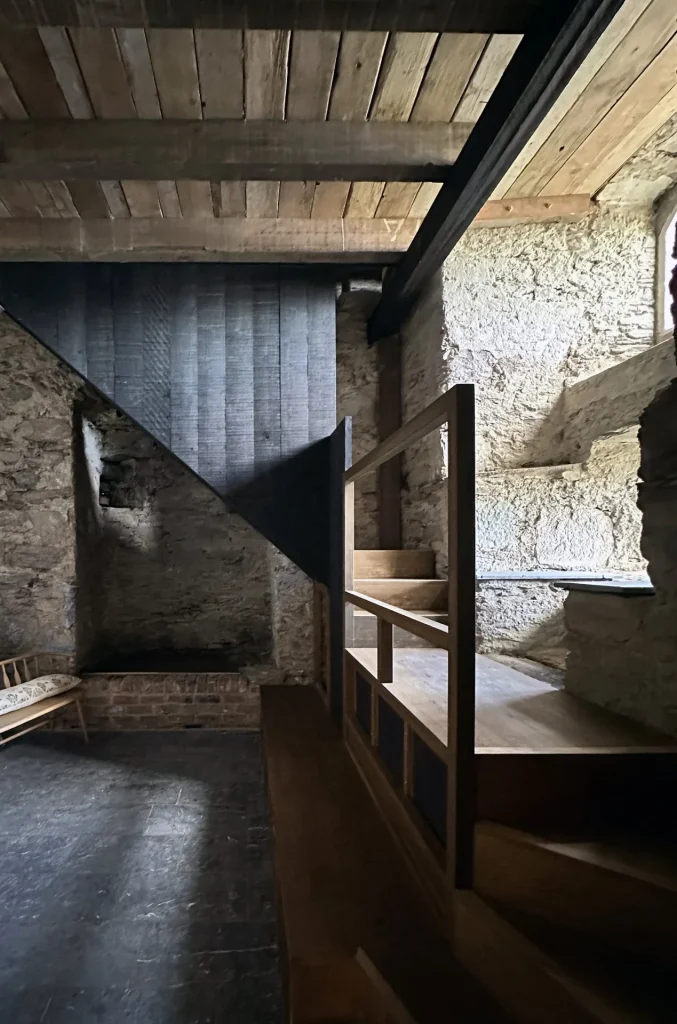
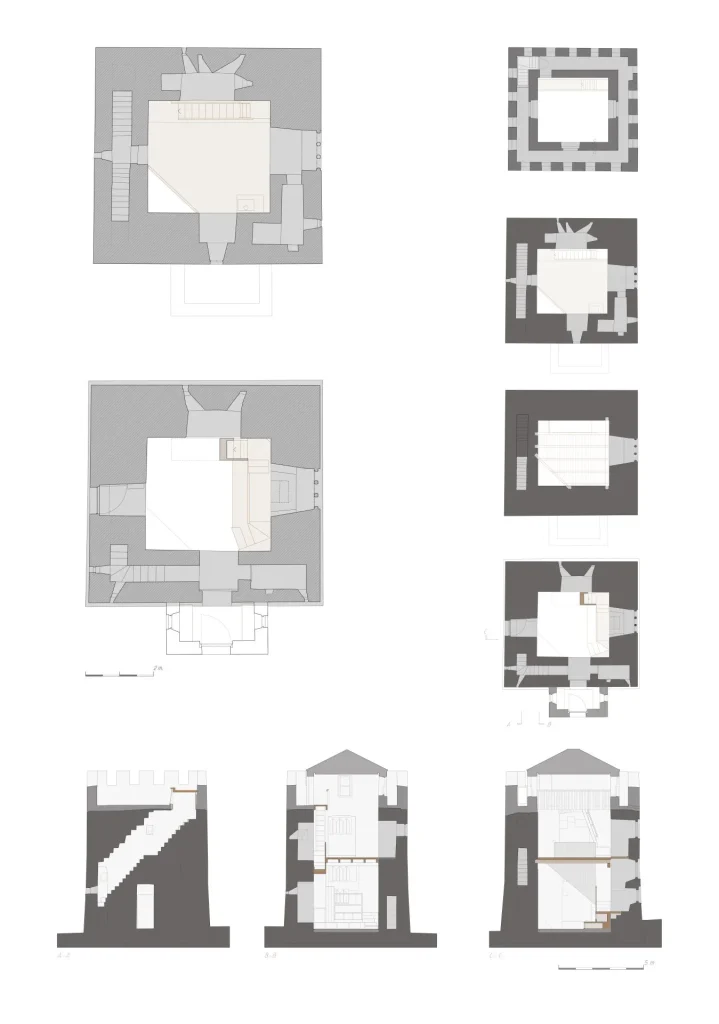
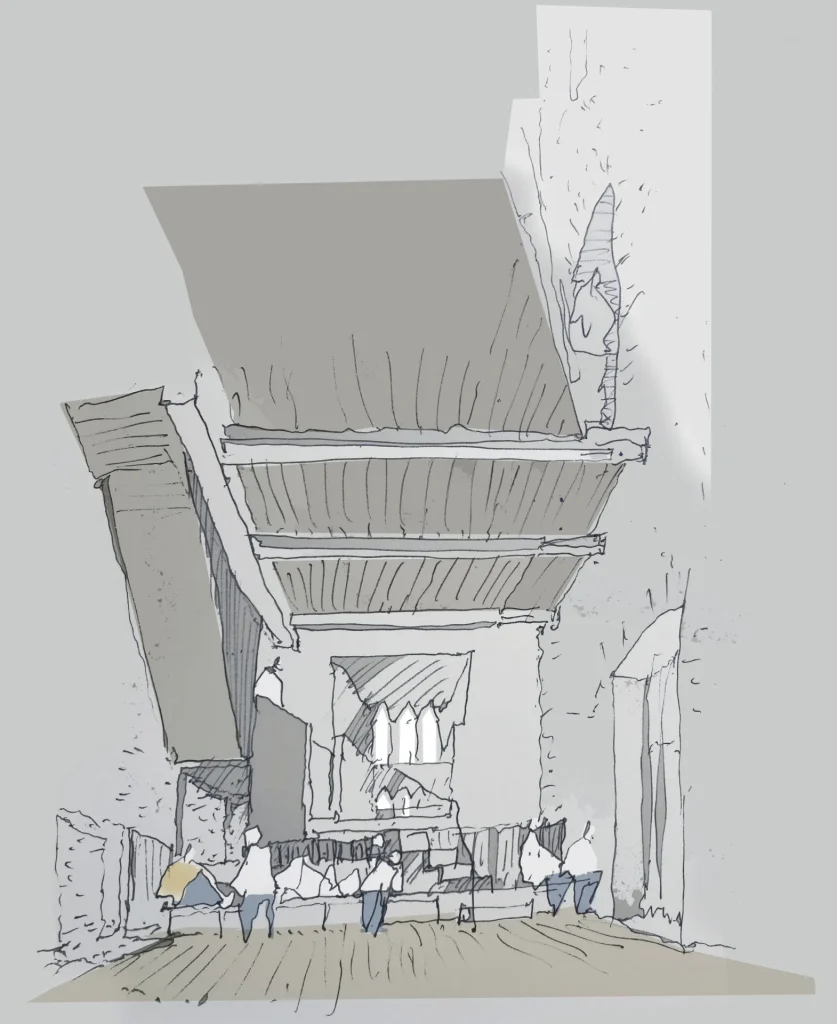
The new timber stairs from ground to middle floor is highly nuanced: the first half flight is absorbed into a raised seating dais responding to the room and its social purpose; the second half flight is an enclosed timber volume open to the inner face of the stone but otherwise concealed behind dark-stained rough-sawn timber boarding. The effect is deliberately discontinuous, a relay of discrete distinctive spatial events, an exercise in raumplan. A lesser architectural talent would have opened the stairs to the gaze of those on the ground floor (and vice versa), destroying any intimacy. From the ground floor the volume of the tower is discernible through the skilful holding back of the middle floor from the flanking walls, a very nuanced moment of continuity in this scheme of discrete pieces. The game continues from the middle floor up and via a ladder out onto a squeezed parapet, circulation interpreted not as a device of didactic legibility but as a sequence of diverse characterful transitions. The two very different routes start at ground floor, a sweet moment indeed in the parapet when the two stairs are revealed as being co-terminal.
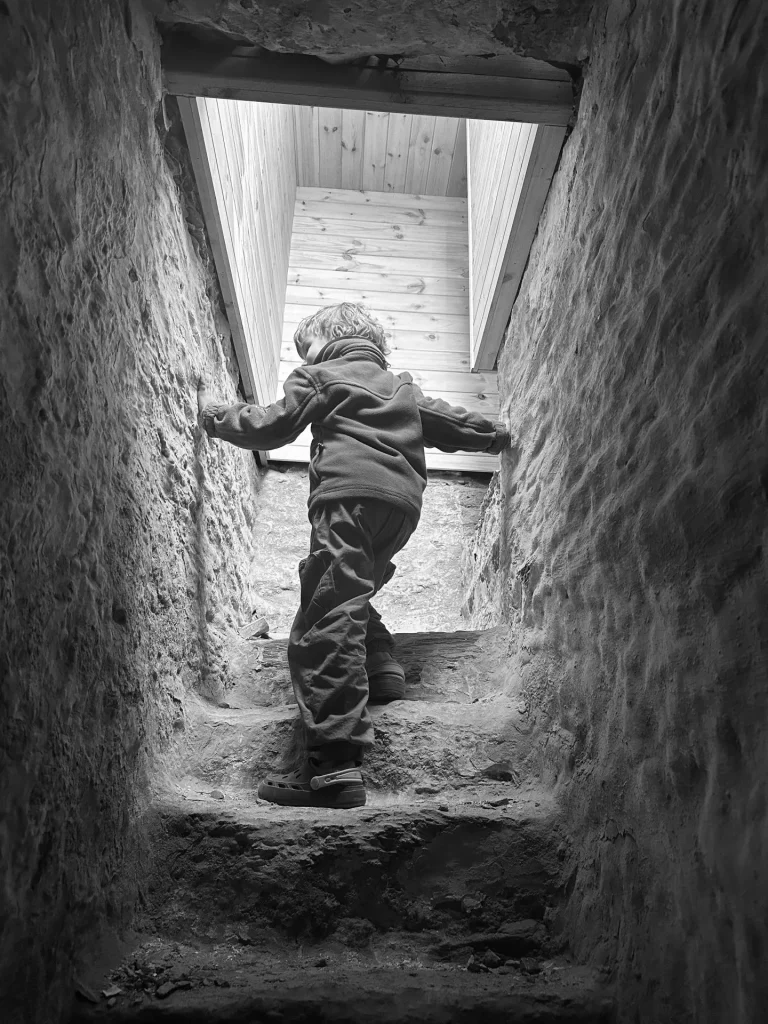
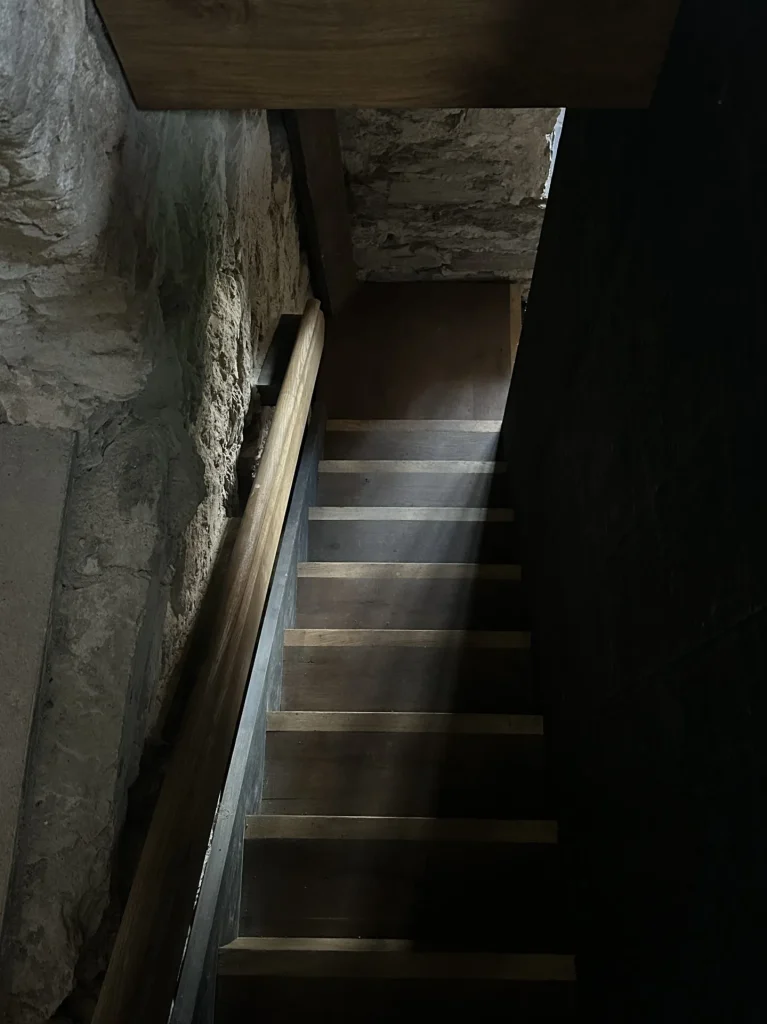
The adjustments to the interior are convincing, the reuse of timbers, attitude to assembly, fit of components, what to leave, the prevailing robustness of the moves. Judgment is critical at this scale of work with on-site decisions, negotiations, balancing contingencies of building and budget. Alone the stone floor somewhat jars in its pattern and scale but its tone compensates. Windows (few) are as pre-existed, the atmospheric interior now wonderfully excited by moments of daylight on the exposed stone and lime mortar, soft warm light, the same daylight absorbed into the dark stained timber.
This is a lovely project, sensitive, apparently simple, nuanced, and useful.
Michael McGarry, Emeritus Professor of Architecture, Queen’s University Belfast
This Village Catalyst project is funded by the Department for Communities, the Department for Agriculture, Environment and Rural Affairs (DAERA), and the Northern Ireland Housing Executive, in partnership with the Architectural Heritage Fund (AHF). Culmore Community Partnership restored a nearby hall and runs a vibrant programme to support the fast-growing rural area that had lacked resource. Culmore Fort is planned as a supportive space dedicated mainly to the emotional and mental wellbeing of children and young people. Beyond its social role, the Fort will serve as a cultural and heritage space.
With the project administered by HED, the focus on conservation aligned with low carbon materials and reuse. The rotten floor was removed to earth and built up with foam glass insulation, limecrete, electric underfloor heating and local limestone. The renewed roof enabled 300mm of hemp flex insulation. Floor beams from reclamation were carefully aligned into original recesses. Joists from the building were re-used as exposed deck. Heating is not designed to reach a set temperature but to provide a tempered dry space with predicted cost/use. The removed sand/cement plaster was used as fill nearby and the Victorian-era flues provided reclaimed brick.
Earthborn clay paints and stabilisers are used with natural stains and oiled oak. Stone windows are direct glazed with putty and burnt sand with a bespoke hardwood mullion and bronze exterior tee. Exterior handles are local cast iron by Dairiada Forge. The exterior benches are American Oregon Pine piles from the WWII-era base opposite.
The building is an outreach room from the local community hub nearby. It is used for short periods for youth therapy, using the beach environment and for local history tours with twelve locally trained guides. It is opened for small groups for limited times, in part to avoid induced traffic to the area. Groups walk from the hub.
Client: Culmore Community Partnership
Architect: Hackett Architects
Structural Engineer: MWL
Quantity Surveyor: JA Tynan and Co
Stage one / planning: IAC archeology +conservation, Starling Ecology
Main Contractor: We-Build
Photography: Elyse Kennedy + Mark Hackett
