
No products in the basket.
Newry, Mourne and Down District Council (NMDDC) has acknowledged that it is struggling to reduce its backlog of planning applications, being in receipt of the second-highest volume in Northern Ireland.
The Council said it had introduced an action plan to help planning officers tackle legacy applications and had developed proposals to amend its internal structures to address ongoing challenges. The proposals are being presented to elected members ahead of their publication by the end of 2026.
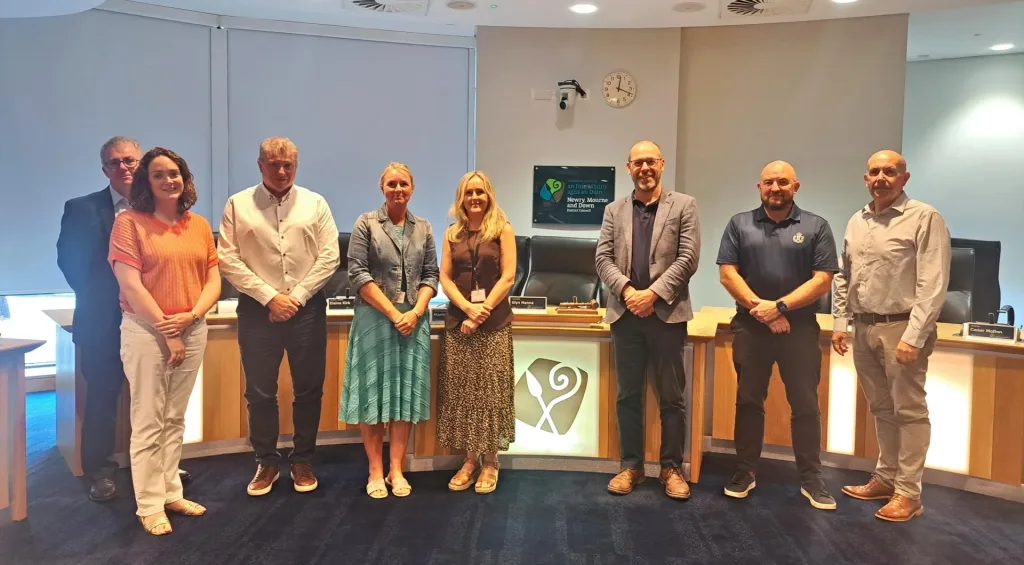
RSUA members heard the update at a meeting today with the Council’s Assistant Director of Regeneration, Jonathan McGilly, alongside Planning Mangers Lois Jackson and Annette McAlarney.
RSUA was represented by new Local Group Chair, Brigin Fegan, together with Bernard Dinsmore, Barry Hillen and William Wallace.
Local Development Plan progress
Like all councils in Northern Ireland, NMDDC is preparing an LDP to provide the primary basis for determining local planning applications.
The LDP comprises two parts: the Plan Strategy, which sets out a strategic policy framework across a range of areas, including housing, employment and infrastructure; and the Local Policies Plan (LPP), which implements the Strategy through more detailed measures such as zoning and settlement limits.
In June 2025, the Council published its Draft Plan Strategy. NMDDC’s LDP timetable was revised from June 2026, with the Strategy now expected to be adopted by the end of 2027, followed by publication of the draft LPP for consultation in 2028–2029.
Plan Strategy matters
RSUA advised that NMDDC should communicate any changes clearly and in advance of the Plan Strategy being adopted and coming fully into effect.
The Council acknowledged this concern, noting in particular that changes were anticipated in relation to rural development and the provision of social and affordable housing.
NMDDC reported that several people submitted comments and objections on the Draft Plan Strategy, but a significant number did not properly address the “soundness” tests set by the Department for Infrastructure (DfI).
The Council advised that parties making representations should refer to DfI’s guidance on soundness before submitting comments.
Planning Application Validation Checklist
NMDDC’s Planning Application Validation Checklist was published in May 2026.
RSUA believes that, where development does not enhance nature, it should at the very least protect it. However, we have observed a challenge in the planning process regarding the undertaking of seasonal species surveys in order to secure validation of an application.
Some planning authorities, including NMDDC, require applicants to submit both a Biodiversity Checklist and any ecological surveys identified by that checklist up front.
A shortage of ecologists and delays in responses from the Northern Ireland Environment Agency (NIEA), which reviews the checklist, mean architects risk applications timing out, as many species surveys can only be undertaken during specific seasonal windows.
RSUA therefore recommended that a completed Biodiversity Checklist should be sufficient to validate an application initially, with any required seasonal surveys submitted later in the process.
The Council said it did not intend to change its approach, arguing that permitting applications to proceed in this way would significantly increase the workload of planning officers by increasing the number of live applications requiring assessment at a time when they are already trying to resolve an existing backlog.
However, NMDDC added that the Checklist is subject to routine review to ensure it remains effective.
Planning improvement update
There has not been improvement in overall planning application processing times in NMDDC, according to the latest planning statistics published by DfI.
At the end of 2025, the Council had 561 planning applications that had been live for more than a year, 147% higher than the Northern Ireland average of 227. This represented a 23% increase in the Council’s legacy applications from the end of 2024, when it had 430 such applications, 96% higher than the Northern Ireland average of 220.
The balance of applications in the district is heavily skewed towards local applications. Across the first three quarters of 2025, the Council received 18 major applications compared with 851 local applications.
Planning performance for local applications remained largely unchanged during this period. The average processing time was 46.8 weeks, 139% longer than the Northern Ireland average of 19.6 weeks. During the same period in 2024, the average processing time was 46.3 weeks, 142% longer than the Northern Ireland average of 19.1 weeks.
Additional items
RSUA asked the Council whether Certificates of Lawful Use or Development (CLUDs) could be issued to applicants more promptly and subsequently published online.
The planning service agreed to publish its policy on CLUDs on the Council’s website to provide greater clarity but advised that the issuing of CLUDs is subject to the same processing delays as planning applications generally.
Further engagement
If you have any questions or comments about this meeting, or would like to join the RSUA Newry, Mourne and Down Local Group, please contact Curtis Large, RSUA Policy and Public Affairs Officer, at curtis@rsua.org.uk
