No products in the basket.
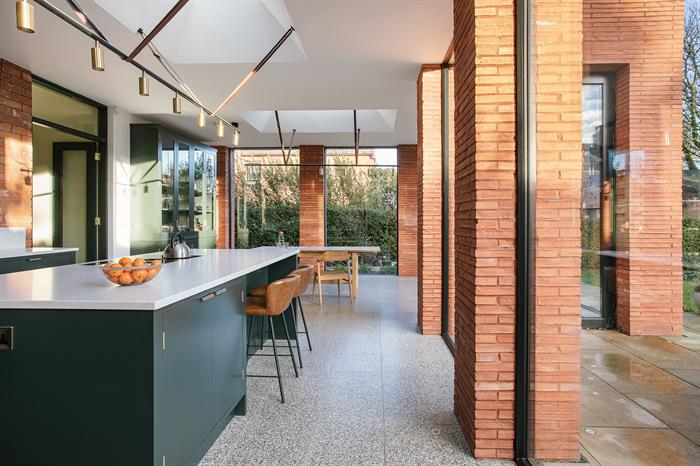
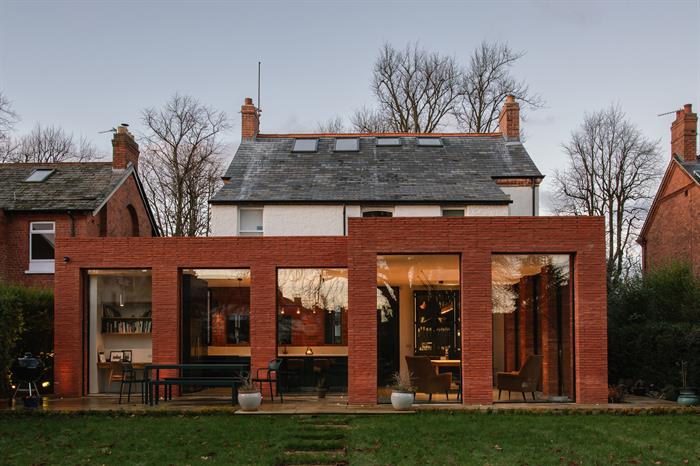
This monumental, colonnaded extension to the rear of a detached 1912 Edwardian house makes the kitchen a seamless link between house and garden, indoors and out, and old and new. The warren of service spaces with random openings and adhoc accretions that are typically found to the rear of period houses are replaced with a coherent space more in proportion with the grandeur of the front of house. Employing a form, materiality and scale that evoke a public building, the design intentionally places importance on the kitchen as the heart of domestic (and often social) life – the agora of the contemporary home.
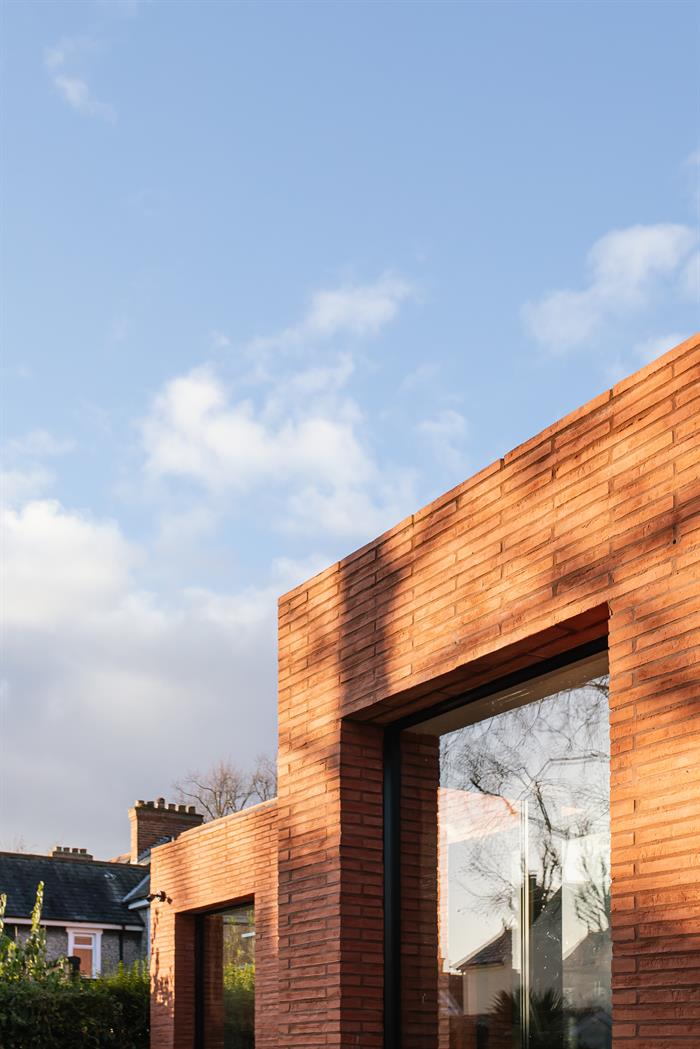
Very little of the existing built fabric is removed. To achieve generous ceiling height, the extension is positioned beyond the rear return, with its floor level stepped down towards the garden. Long format bricks with colour-matched mortar give a monolithic appearance to its massive piers – distinct from, yet tonally blended with, the brick of the original house. Interest is added to the small front-facing elevation through recessed brickwork courses. To avoid visible flashing at the top of the walls, the parapet was detailed with a brick coping course fixed over the roofing membrane and impregnated with siloxane based sealant to ensure longevity. The walls were built
counter-intuitively, with windows installed into the steel frame before the brickwork was built up around them. This allowed much of the aluclad frames to be concealed within the piers, giving a minimal look without the expense of slimline glazing. The glazing beads remain exposed, to facilitate future replacement of the glass, as required.
The deceptively simple plan follows a rigorous grid to which the internal layout adheres. A pantry and study area are tucked discretely into one solid-walled corner where they don’t interrupt the colonnade. The L-shaped plan generously pushes out into the garden to create space for informal seating, surrounded by greenery. One set of double doors gives access to a level patio area and the garden beyond. Three irregular windows, matching neither in size nor shape, are retained within the exposed brick rear wall of the original house, adding delight and a nod to the
past. Now lined with oak, these openings sit above the kitchen worktop, providing links, as useful as they are delightful, between the kitchen and a newly formed playroom.
With its southerly orientation and floor-to-ceiling glazing on three sides of the room, light and shadow dance across this space throughout the day and the changing seasons. Modest flat rooflights are centred over the room’s two focal points – the island and the dining table. Their impact is heightened through tapered reveals in the flat ceiling that spread daylight farther across the room. Artificial lighting is suspended below from leather straps, fixed at either side of the reveals in a triangular inverse of the taper above, while spots in the floor, centred on piers inside and out, up-light the texture of the handmade bricks, bringing new character to the space after dark.