
No products in the basket.

This post is the first in a series of AI blogs, prepared by the RSUA Digital Design and Innovation Committee. The series is aimed at providing information on evolving legislation, guidance, resources, and industry developments. More information on the Committee can be found here.
The RSUA Digital Design and Innovation Committee has been tracking how AI is developing and what it means for our work as architects. We looked at different ways of reporting on something that moves this quickly and settled on a monthly series as the most practical approach.
This series ‘AI in Practice’ is designed to meet members wherever they are. If you have never used an AI tool, we will help you start. If you are already using them daily, we will cover the governance, regulatory and risk territory that responsible use demands. Each post will be short, practical and honest about both the opportunities and the limitations.

For architects this is not an abstract conversation. The same tools generating concept imagery are also drafting specifications and beginning to appear inside software many of us rely on daily. Adobe has embedded generative AI across Photoshop and Firefly. Autodesk is integrating AI functionality into the BIM ecosystem. The Northern Ireland Executive has published a draft AI strategy setting out how it sees artificial intelligence shaping public services and the wider economy.
Whether you have already used a chatbot to help draft a client email or remain unconvinced about its usefulness, this technology is no longer something that can comfortably be watched from the sidelines.
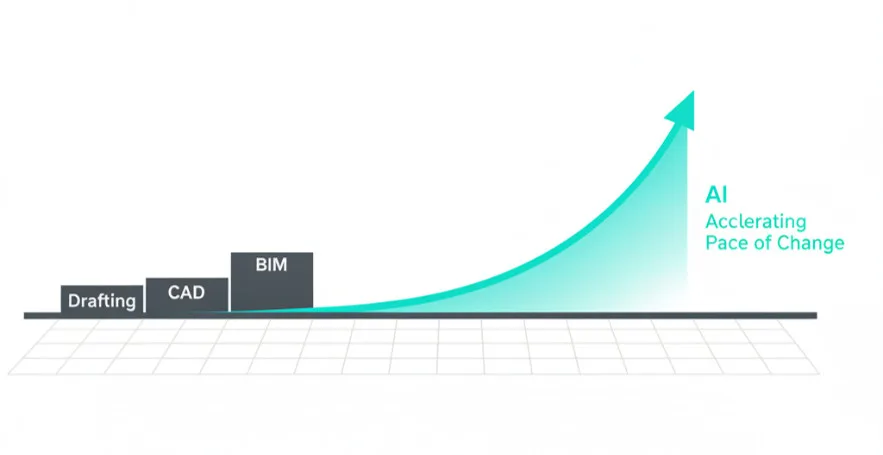
For architects the most useful parallel is the move from drawing board to CAD, and eventually from CAD to BIM. Each shift redefined what basic competence in the profession looked like. Many practices held off on BIM until procurement requirements made engagement unavoidable. AI is following a recognisably similar path, though the pace is considerably faster.
Despite the way it has been discussed over the last number of years, artificial intelligence is not a new concept. The term was introduced in 1956. Alan Turing had explored a similar question several years earlier in his landmark paper Computing Machinery and Intelligence, which opens by asking: “Can machines think?”
What changed was not the idea but who could access it and what it could actually do. ChatGPT reached one million users in five days and one hundred million within two months. Instagram took two and a half years to reach the same number. That pace of adoption is what separates this moment from what came before.
If you are exploring AI tools for the first time, it is important to understand how free platforms handle your data. Many free-tier AI services use the information you provide, including anything you paste or upload, to train their models. In a profession that handles sensitive client information, commercially confidential project data and material covered by contractual obligations, that presents a real risk. We will cover data handling in detail in a later post, but the short version is this: be very careful about what you share with any platform, and understand the terms before you use it for professional work.
The next post explains what AI actually is in terms that make sense, what the tools do, and what architects are already using them for.
This article was written with support from AI tools including ChatGPT and Claude to assist with refinement. All images have been generated with support from AI tools.
