
No products in the basket.
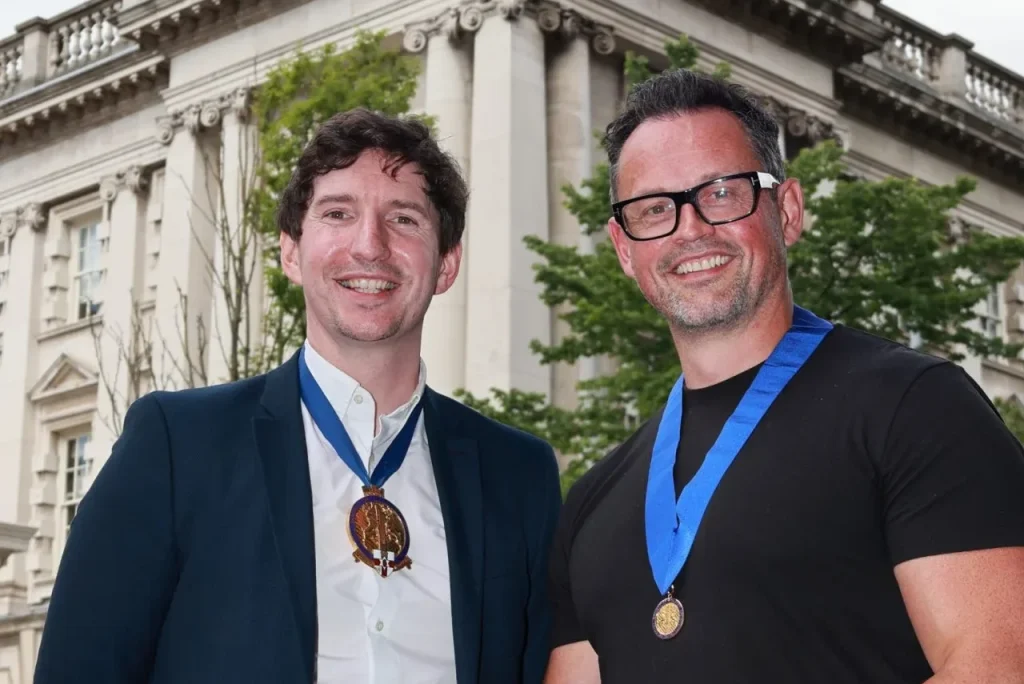
James Grieve took on the role of RSUA President at the RSUA Annual General Meeting on 29 May 2026. This is his inaugural speech.
It is a tremendous honour to stand before you today as the incoming President of the Royal Society of Ulster Architects.
Before I go any further, I would like to thank our Immediate Past President, John Lavery, for his support, encouragement and mentorship during my time as Vice President, and indeed for the tremendous job he has done as President over the last two years.
Through the RSUA I have had the opportunity to get to know John well, and what has always struck me is how people-centred an architect he is. Whether it is his clients, his staff, or his colleagues, John has shown himself an extraordinarily generous, and always professional person.
I have also taken to heart John’s belief in preserving “white space” in the diary – making sure that the demands of practice are balanced with time for thought, reflection and creativity.
And, of course, of his catchphrase many of us have heard countless times: “Keep on architectin’.”
John has been a generous President, a thoughtful leader, and someone who somehow managed to make Council meetings considerably more enjoyable than they really ought to have been.
As I take over the role, I am very conscious that I have some very big shoes to fill. Although, for me, perhaps not quite such dazzlingly white ones.
Being an architect is difficult.
As architects, we are expected to hold an almost impossible number of things in our heads at once. We are asked to be visionaries – to think about how people live, how buildings operate, how cities function, how spaces make people feel. We carry a responsibility to shape people’s daily lives, and with that comes an extraordinary opportunity to make those lives better.
At the same time, we are balancing impossible budgets, tight deadlines, statutory constraints, consultant coordination, procurement routes, sustainability targets, stage reports, fee pressures, 30 years of professional liability – all while somehow being expected to know every last jot and tittle of an ironmongery schedule.
And it is because it is difficult that I have seen many friends and colleagues – many brilliant designers – lose their love for the profession.
Some leave architecture entirely.
And perhaps even worse, despite their disaffection, some stay.
I say even worse, because I believe there is nothing more dangerous for our profession than architects losing their affection for the act of architecting itself.
When that happens, architecture risks becoming little more than administration. A dreary exercise in compliance and box-ticking.
Buildings which satisfy firmness and commodity, but lacking in that one quality that relates to the human experience – delight?
A memory that has stayed with me for years was hearing John Reid of Robinson McIlwaine recite a poem at the RSUA’s Architects as Artists event. In it, John imagines the Emperor Hadrian arguing with his architect about the Pantheon.
I obviously cannot recall the entire poem, but one line has stayed with me ever since.
Hadrian turns to his architect and says:
“There’s a great big fucking hole in the roof where water can get in. Why have you designed this?”
And of course, despite this entirely reasonable observation, the architect persists.
Because the architect understands something larger. That architecture is not merely about keeping the rain out. It is also about beauty, wonder, delight.
We all know construction is collaborative but I remain absolutely convinced that the architect occupies a unique role when it comes to design leadership.
Or, to quote my favourite philosopher, Liam Gallagher: “We see things they’ll never see.”
Now, that is not some divine superpower bestowed upon architects from above. It is the product of education, training, experience, curiosity, observation, travel, drawing, discussion, criticism, failure, and lifelong engagement with the world around us.
One of my favourite experiences as an educator is watching first-year students slowly let go of their assumptions about what buildings are. You can almost see their brains rewiring in real time as they realise architecture is not simply the production of drawings; its not four walls and a roof and a chimney pot.
Architecture is the ability to navigate contradiction.
Between structure and sustainability, between comfort and operability, between cost and value, between technical performance and human delight.
Architecture sits simultaneously as technical discipline, social infrastructure, and artistic endeavour. It is a difficult undertaking.
Importantly, education does not stop at graduation. Study trips, sketchbooks, conversations, exhibitions, walking unfamiliar cities; looking up at details nobody else notices; continuing to care deeply about the built environment long after office hours have ended.
That continued curiosity is not indulgence. It is part of what makes architects invaluable leaders of the design process.
Because design decisions carry enormous weight in people’s lives.
I was reminded of this recently through a post by Sarah Brady on the Women in Architecture platform discussing the design of fire stations.
She described how firefighters return there immediately after traumatic incidents – often still in a heightened fight-or-flight state. The fire station becomes their first moment of decompression. A place where calmness, warmth, familiarity and dignity can support recovery.
And I thought that was such a profound reminder of what architecture actually does.
Last year, my father was diagnosed with dementia and, during a very difficult period for my family, he had to be placed into emergency care. Without going into too much detail, I can honestly say the building he was, thankfully only temporarily, housed in was perhaps one of the most distressing environments I have ever experienced.
Deep-plan corridors, very little natural light, confusing circulation. No sense of warmth, calmness, orientation, or humanity.
Perhaps my sensitivity to architecture made the experience even more difficult. But it confronted me with an overwhelming truth: bad architecture can actively diminish human dignity. It can make already difficult lives worse.
And conversely, good architecture – thoughtful architecture – can make lives better.
That, to me, is the generous act of design. And it is why our profession matters.
If architecture matters, then architects themselves must also be valued properly. Not only culturally, but professionally and economically too.
And that, in many ways, is why I have devoted so much of my own time to the RSUA. Not simply because it is a professional body, but because it is a society. And I think that distinction matters.
None of us become architects alone. We learn from tutors, colleagues, critics, mentors, employers, clients and friends. We learn through conversation, debate, disagreement, encouragement and shared experience.
They happen at Architects as Artists events, where architects are reminded that creativity extends beyond the drawing board; where John Reid can regale us with profanity laden poems.
They happen through Women in Architecture, where we hear the experiences of others and better understand the profession through perspectives different from our own.
They happen through the Early Career Architects Forum, helping younger architects navigate what can often feel like an overwhelming profession.
They happen through our committees – Sustainability, Education and Careers, Conservation, Practice and many others – where architects give their time freely in pursuit of something larger than their own practice.
Over the last number of months I have had the privilege of attending many of those committees, and I have been struck repeatedly by the generosity of the people involved.
Architects volunteering their expertise, sharing knowledge, debating difficult issues, advocating for better outcomes, working together to strengthen the profession for everyone.
And I am particularly looking forward to attending my first Lunch Club, where I hope to learn from those whose experience vastly exceeds my own.
Because that, to me, is the true value of the RSUA. Not simply what it does for us, but what we do for one another.
A responsibility to support colleagues; to mentor those coming behind us. To advocate for good design. To contribute to the collective good of the profession. To remind others, and perhaps ourselves when we need it – why we do what we do.
One phrase I have always loved came from our past president John himself, and one he would often use to close Council meetings: “Keep on architectin’.”
And honestly, I think that captures the profession beautifully. Because you are never just doing a door schedule. You are never just attending a PAD meeting. You are never just answering another contractor query. You are participating in the ancient and noble act of shaping the infrastructure of human life.
The profession loses itself when it forgets that architecture is not administration alone, but a civic art undertaken in service of human flourishing.
And for me, that is precisely what the RSUA should be. A society that supports architects not only technically and professionally, but intellectually, creatively and culturally.
A society which reminds us why we entered this profession in the first place, which encourages study tours, debate, curiosity, discussion, sketching, building visits, lifelong learning and engagement with the wider world. A society which occasionally encourages us to lift our heads above the drawing set and remember that we are architects.
That we are still architecting.
It is an enormous privilege to take on this role, and I look forward to a presidency where I will do my very best to advocate for architecture, for architects, and for the extraordinary value thoughtful design brings to people’s lives.
Thank you.
